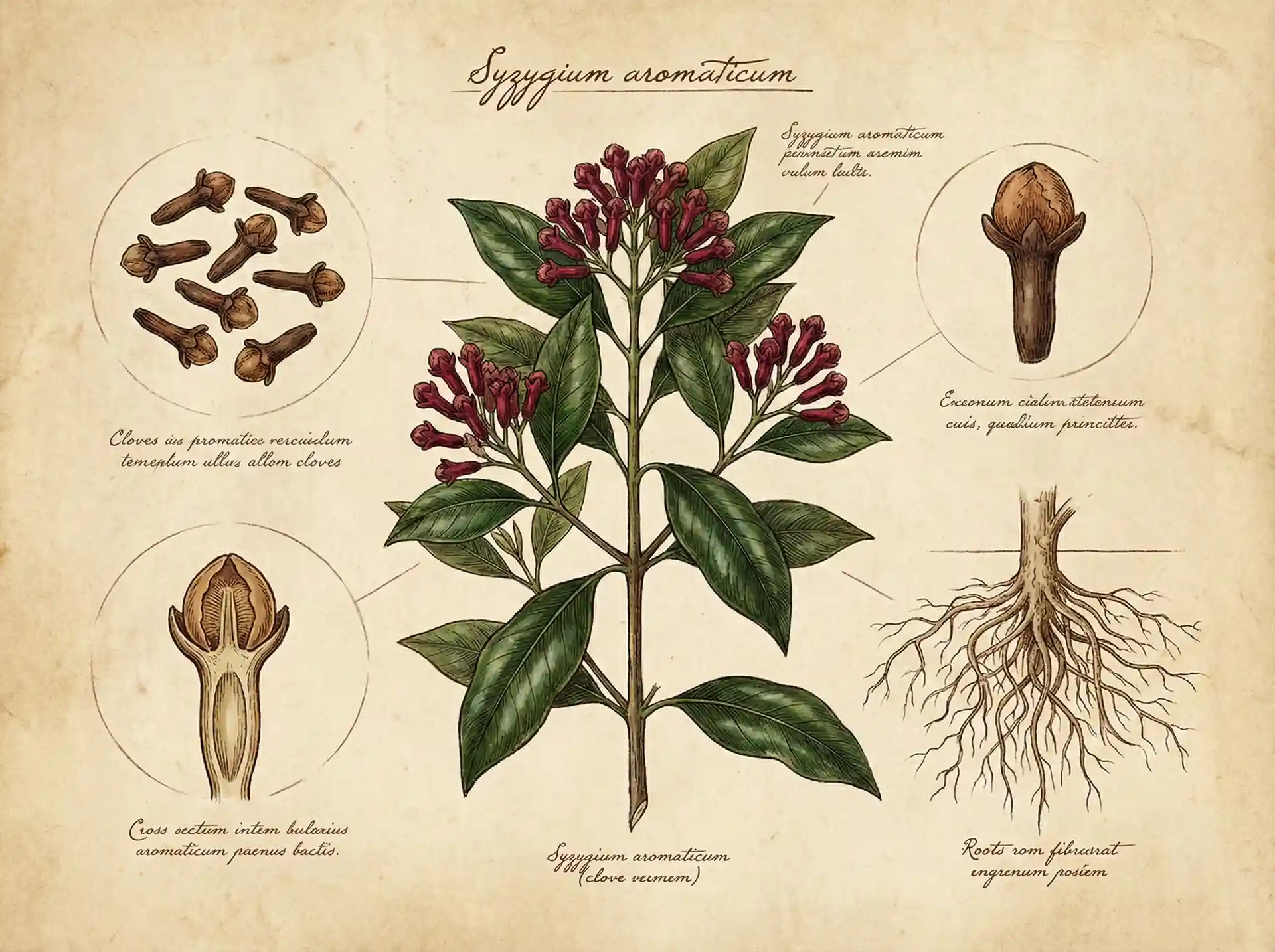
Profile
- Latin name:Syzygium aromaticum
- Family:Myrtaceae / myrtle family
- Extraction:distillation
- Note:middle-base
Before use, see where dilution percentages, phototoxicity notes, and notes for children or pregnancy belong. Aroma science.
Opening scene
Has a toothache ever arrived in the middle of the night when you could not see a dentist at once? Have you, in flu season, worried that a virus would reach the people at home? You want an old and reliable force that can step forward in an urgent hour: easing pain, and also building an unseen layer of protection.
That force lives in clove essential oil. The small flower bud, shaped like a nail, holds a depth of energy that is easy to underestimate.
Its past and present: an ancestor of dental care
Clove comes from the Maluku Islands of Indonesia. The dried bud looks like a small nail, which is how it was named: Clove comes from the Latin clavus, a nail. Clove has long been an important spice and medicinal material. Before modern dental anaesthetics, Eugenol was a principal ingredient dentists used for pain relief and disinfection. Even today many dental materials still contain Eugenol. Clove essential oil, drawn from the dried buds, keeps that old wisdom of easing pain and meeting microbes.
The familiar magic: an emergency ally for toothache
The chief constituent of clove essential oil is Eugenol, with a marked numbing, pain-easing, and antimicrobial action. For toothache, gum discomfort, and mouth ulcers it can offer a fairly quick ease, and it is one of the oils often remembered in a home first-aid box.
Small dental first-aid ideas
- A cotton-swab method for toothache: Dilute 1 drop of clove essential oil in 1 teaspoon of coconut oil. Dip a cotton swab and touch it gently around the painful tooth or gum, avoiding any open wound. It can ease the pain fairly quickly and buy time until you see a dentist.
- Ease for a mouth ulcer: Dilute 1 drop of clove and 2 drops of lavender in 5ml of coconut oil and touch the ulcer with a swab. This helps healing along and eases the discomfort.
- A homemade rinse for fresh breath: In 100ml of warm water add 1 drop of clove and 2 drops of peppermint essential oil. Shake well and rinse — do not swallow. It helps reduce microbes and keep the breath fresh.
An unexpected talent: meeting infection and guarding the household
Clove essential oil has a strong antibacterial, antiviral, and antifungal capacity. In a season of circulating illness it can help clear the air and make the rooms feel safer for the family. It also supports circulation, so the body can meet infection with more resource.
Protection and purification
- Clearing the room in flu season: Diffuse 2 drops of clove, 3 drops of lemon, and 2 drops of eucalyptus together to help reduce disease-related microbes in the air.
- A foot soak for fungal bother: Add 2 drops of clove and 2 drops of tea tree essential oil to warm water (dilute them first in milk) and soak the feet for 15–20 minutes. This helps with fungal discomfort such as athlete’s foot.
Guarding of the soul: a safe energetic boundary
The energy of clove is about protection and purification. Its spicy, warm, slightly penetrating scent helps us draw a clear line in daily life and meet relationships or atmospheres that drain us. Clove reminds us: protecting yourself is not selfishness. It is what makes giving possible.
A practice of energetic protection: When you feel affected by a draining atmosphere around you, or you must enter a place that unsettles you, dilute 1 drop of clove essential oil and apply it to the nape or the wrists. Imagine a golden shield around you, so you can meet whatever is outside with composure.
A whisper from the small universe
- Skin irritation: At a higher concentration clove essential oil irritates the skin. Always dilute it, and avoid using it over a large area of sensitive skin.
- Use care in pregnancy: Clove can encourage uterine contraction. Avoid it during pregnancy.
- Do not put it straight on the teeth: Although clove can ease toothache, never apply undiluted oil directly to teeth or gums, or it may irritate them.
Clove, this early figure of dental care, uses an old and reliable wisdom to guard the ease of the body and the boundary of the mind, so that when you need it, a solid support is there.