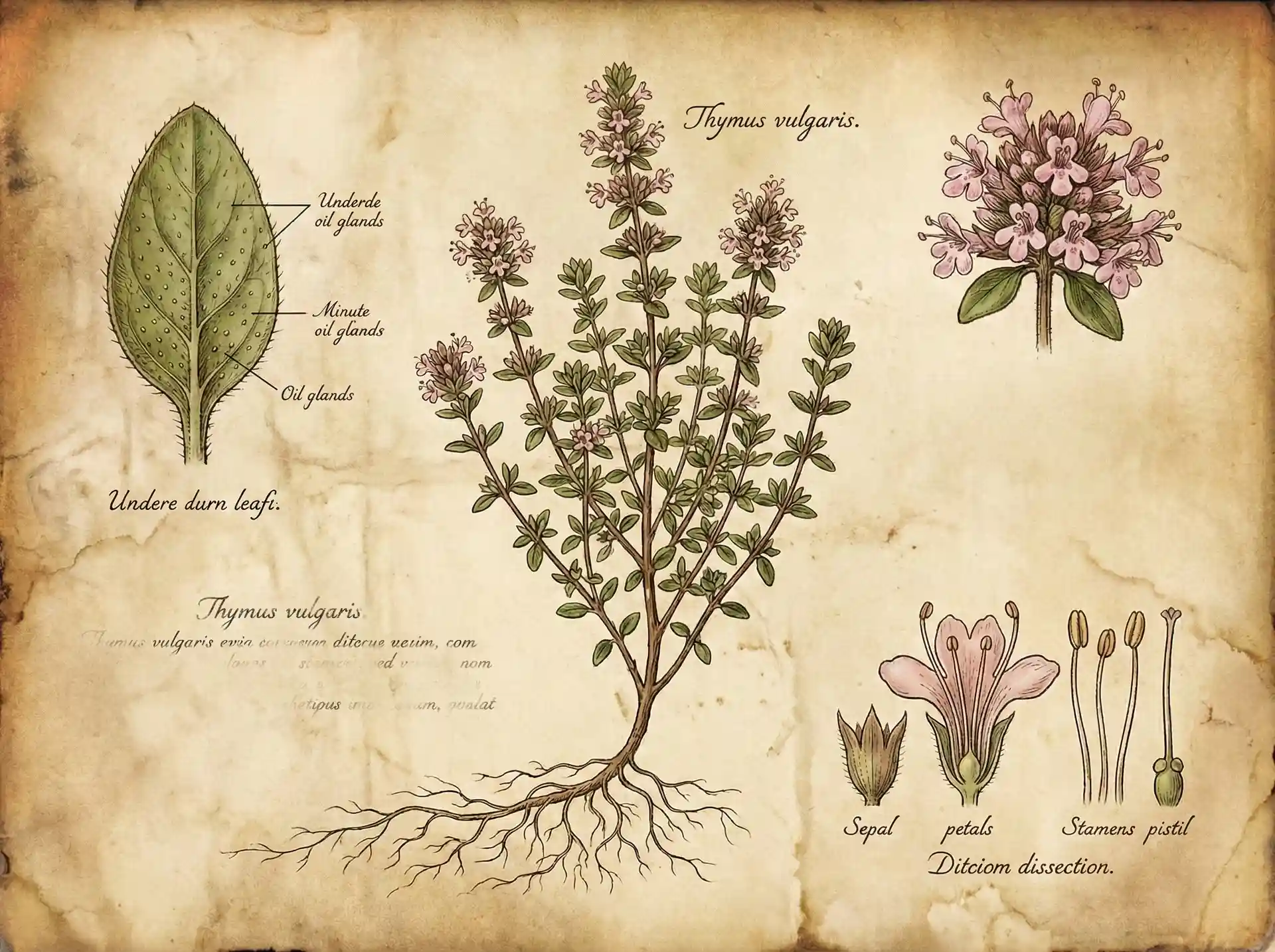
Profile
- Latin name:Thymus vulgaris ct. Linalool
- Family:Lamiaceae / mint family
- Extraction:distillation
- Note:middle-top
Before use, see where dilution percentages, phototoxicity notes, and notes for children or pregnancy belong. Aroma science.
Opening scene
In flu season, have you wished for an unseen net of protection at home? Facing a challenge, have you felt short of the courage to step forward? You want a force that can guard a family’s health and also light the will inside, so that even in difficulty you can lift your head.
That force is held in thyme oil — a herb common in the kitchen, carrying a depth of energy easy to underestimate.
Then and now: the “herb of courage” of warriors
Thyme is a small shrub native to the Mediterranean. Its name comes from the Greek thymos, meaning courage or soul. In ancient Greece, fighters bathed in thyme before a campaign, to take courage and strength; knights of the Middle Ages wore it as a charm. In daily life it was long used to preserve and to season, and its notable antimicrobial character was already recognised. The oil, drawn from the leaves, keeps that old energy of protection and encouragement.
The familiar gift: a gatekeeper of immunity
Thyme oil has a marked antimicrobial, antiviral, and antifungal character, a useful helper when the seasons change and immunity needs support. It is said to encourage white blood cells and the body’s defence. For respiratory infection, cough, and a sore throat, it can also offer real support.
Protection and clearing
- A room clear for flu season: diffuse 2 drops thyme, 3 drops lemon, and 2 drops eucalyptus, to help clear microbes that travel in the air.
- A gargle for a sore throat: in 100ml warm water, 1 drop thyme and 1 drop lemon, well diluted. Gargle, and do not swallow. It can ease discomfort in the throat.
- A footbath to support resilience: in warm water, 2 drops thyme and 2 drops ginger, first dispersed in milk. Soak the feet for 15 minutes. It can support circulation and resistance.
An unexpected talent: a catalyst of courage in the mind
Beyond the body, thyme can “guard” a state of mind. In Greek culture it was bound to courage, and its scent can wake inner fight and decision. For someone long tired, short of drive, or unable to choose, the scent is like a clear call to gather courage for action again.
Light the inner fire
- A scent before a challenge: before an interview, an exam, or a negotiation, dilute 1 drop of thyme in 5ml jojoba and apply to the wrists. The scent helps call up courage and confidence.
- A study diffusion against delay: diffuse 2 drops thyme with 3 drops rosemary. It can help gather attention and follow-through.
Courage of the soul: a warrior’s heart that lives as itself
Thyme’s energy answers its old name, the herb of courage. It is about courage and action. It helps break the bind of fear, so we dare to speak as we are and to work for what we want. The scent reminds us: real courage is not the absence of fear, but choosing to go on while fear is known.
Waking courage: when you shrink and cannot speak for yourself, dilute 1 drop of thyme and apply it over the heart. Close your eyes and ask, “If fear were not here, what would I do?” Let the scent light the warrior’s heart within.
Whispers from a small cosmos
- Know the chemotype: thyme oil has several chemotypes, including thymol and linalool. The thymol type is more irritating and, on skin, needs extra dilution, under 1%. The linalool type is gentler and suits everyday use better.
- Avoid in pregnancy: thyme is quite stimulating and should be avoided in pregnancy.
- Note for high blood pressure: thyme may raise blood pressure. If yours runs high, ask a qualified person before use.
Thyme, the kitchen’s small antimicrobial guard, uses a bright and warm scent to protect health and light courage, so that on the field of a life you can still carry a warrior’s strength drawn from old wisdom.