How to read a dilution percentage is on Aroma Science.
If one carrier is named when people talk about skin repair, it is Rosehip Oil.
It is not the essential oil of the rose flower. It is pressed from the seeds of the rose fruit. Anne Kennedy calls it a storehouse of antioxidants, suited to anyone who wants the skin to age with more ease.
1. Why it has to be virgin
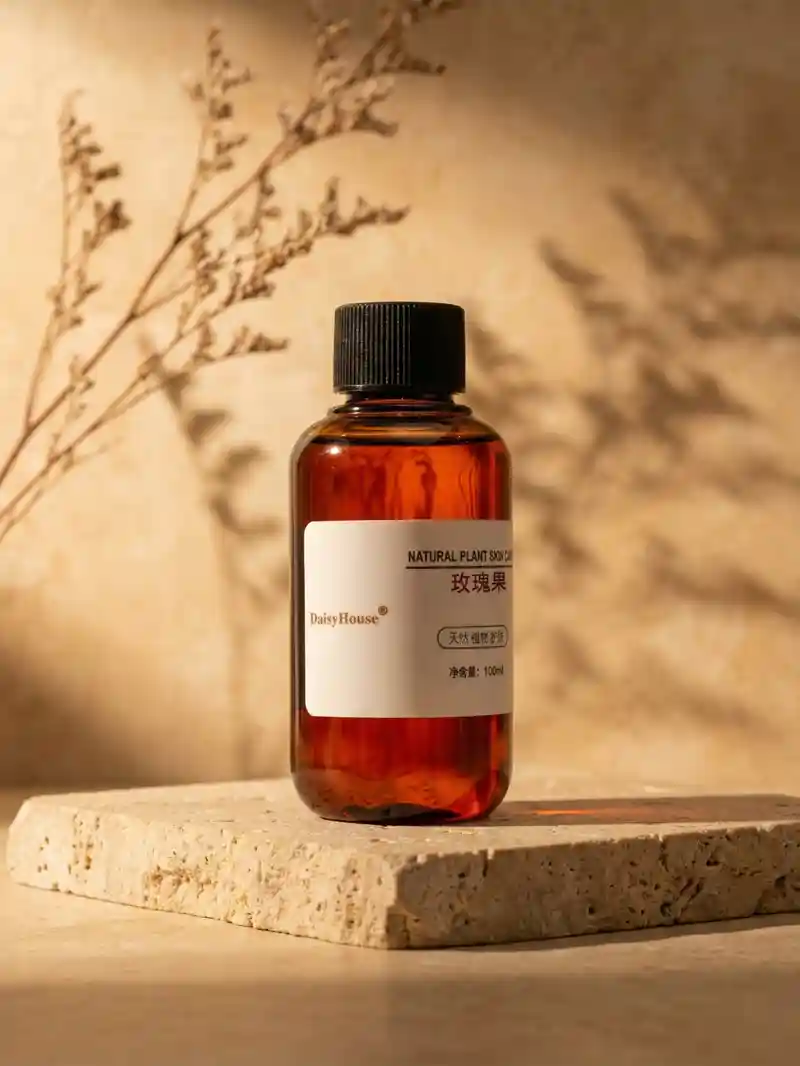
The actives (such as retinoic acid and gamma-linolenic acid) are fragile. Heat and refining destroy them. Virgin rosehip oil is deep gold-orange. It has a herbal scent, and that scent is a sign the actives are still there.
2. What it does
- Marks: acne marks, surgical scars, and stretch marks are the usual reasons people reach for it.
- Tissue: Valerie Ann Worwood calls it a cell regenerator, useful on damaged tissue.
- After sun: it helps skin that has aged in the light.
3. Two classic blends (with sources)
Blend 1: Anti-Wrinkle Night Oil
- Who: mature skin from about 40, when lines and pigment marks are the concern.
- Source: The Complete Book of Essential Oils and Aromatherapy, Valerie Ann Worwood (Page 358)
- Carrier: sweet almond oil 5ml
- Actives: Rosehip seed oil 10 drops + sea buckthorn oil 15 drops
- Essential oils: neroli 6 drops + frankincense 5 drops + lavender 4 drops
- How: blend, then press 2–3 drops over the face each night. Rosehip is the core of this blend.
Blend 2: a repair oil for scars
- Who: new acne marks, and scars after a burn has healed.
- Source: Aromatherapy for Beginners, Anne Kennedy (Page 48)
- Rosehip oil: 1.5 teaspoons
- Apricot kernel oil: 1.5 teaspoons
- Shea butter: 1/2 cup (the base)
- Essential oils: everlasting and frankincense.
- How: this is a repair cream. Rosehip supplies the regenerative part.