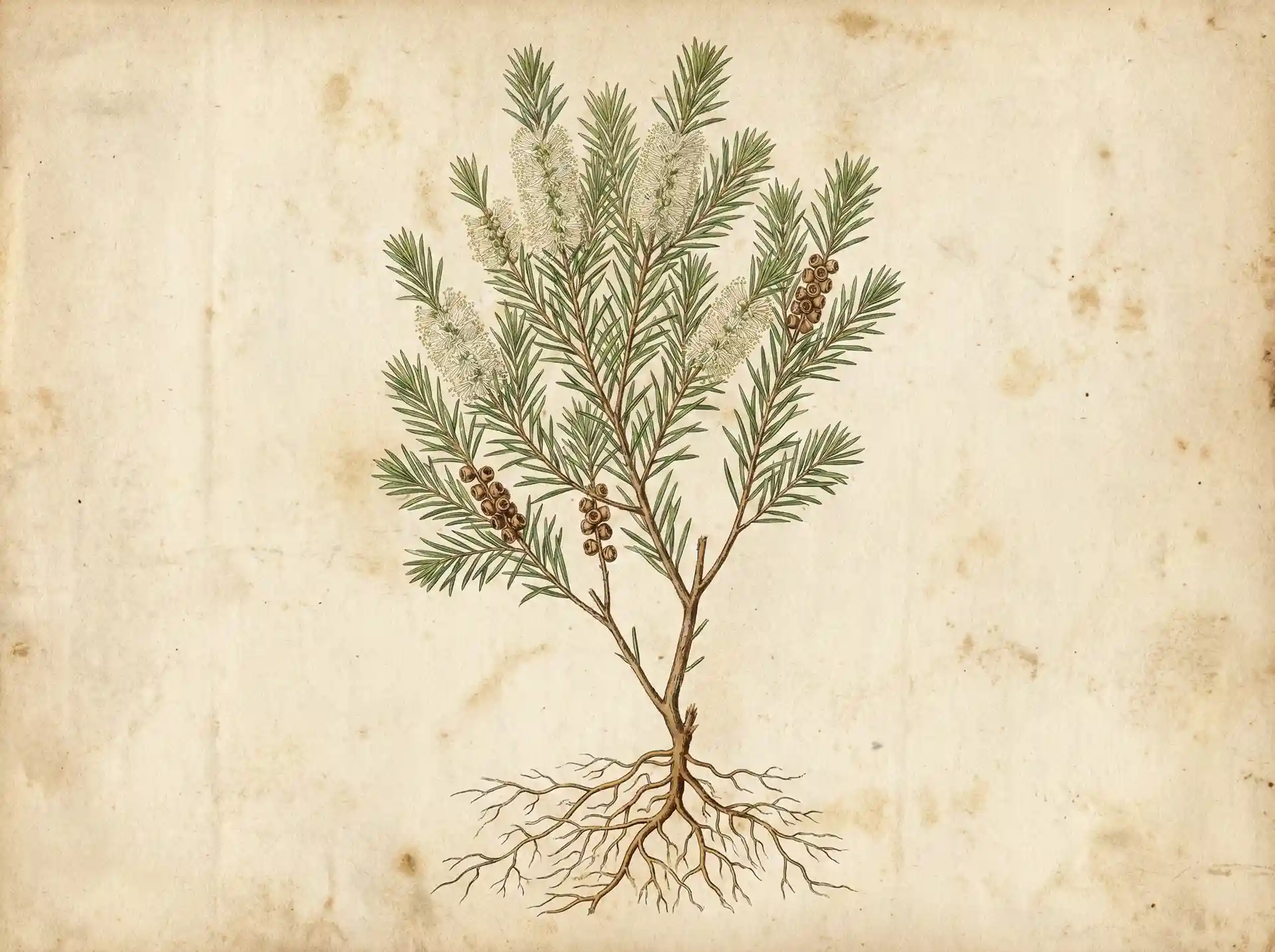
Profile
- Latin name:Melaleuca alternifolia
- Family:Myrtaceae / myrtle family
- Extraction:distillation
- Note:middle-top
Before use, see where dilution percentages, phototoxicity notes, and notes for children or pregnancy belong. Aroma science.
Opening scene
Tomorrow is an important interview or a date. You face the mirror and find an ill-timed surprise: a red, swollen spot announcing itself. Anxiety and frustration rise. Have you also wanted a single gesture that could clear it? Do not worry. In your small cosmos of oils, a green guardian from the Australian continent is ready.
That guardian is tea tree oil. Its slightly medicinal, clean, crisp scent seems to say: do not be afraid, I am here, and what is unclean can be cleared.
Then and now: from an Indigenous remedy to a field oil
Tea Tree has nothing to do with the tea we drink. A few centuries ago, when Captain Cook landed in Australia, he found that local Indigenous people picked the leaves of a particular plant for wounds and infection. They crushed the leaves onto the skin, or boiled them to drink. Seeing the crew do the same, Cook named the plant Tea Tree.
During the Second World War, because of its notable antimicrobial ability, tea tree oil was listed among essential supplies of the Australian forces, used on soldiers’ wounds and skin infections. It was, in a real sense, a hero of the first-aid kit.
The familiar guard: a clearer path for blemished skin
Tea tree’s answer to blemishes comes from its core constituent, terpinen-4-ol. This “general of clearing” has a strong antimicrobial and anti-inflammatory character. It targets Cutibacterium acnes, the bacterium linked with blemishes, helps dry a spot, and eases redness and swelling.
First aid for a blemish
- A precise spot: after cleansing, dip a clean cotton swab in 1 drop of tea tree and touch it only on the red spot, 2–3 times a day. This is for a small local area only. Sensitive skin should dilute first.
- A clearing clay mask: add 1–2 drops to a cleansing mask you already use, such as kaolin or bentonite, mix well, and apply. It suits oily and blemish-prone skin that wants a deeper clean.
- A gentler wash: add 1 drop to a non-foaming cleanser. It can help keep new spots from forming and leaves a fresh, clean feel.
An unexpected range: a purifier of living space
Tea tree’s guard reaches far beyond the face. Its antimicrobial and antifungal character makes it a capable helper for home cleaning and for clearing the air.
A healthier home
- A simple multi-use spray: fill a 100ml spray bottle with water, add 15–20 drops tea tree and 10 drops lemon, and shake. Wipe tables, door handles, kitchen surfaces, even a child’s toys. Plain, and easier on the mind.
- A laundry companion: add 3–5 drops to the wash. It helps reduce bacteria and stale smells on clothes and towels, especially in a damp season.
- Fresh care for the feet: troubled by athlete’s foot or sweaty feet? Add 3–5 drops to a warm footbath and keep the habit. It can restrain fungi and support healthier feet.
A clearing of the spirit: a sword of courage against heavy feelings
Tea tree’s clean, penetrating scent does not only clear the material world. It can also clear the inner one. When the head feels dull, when low feelings crowd in, or when confidence and strength are thin, the scent is like a sword of courage. It helps cut the weeds of the mind and restore clarity and a steadier force.
A ritual of mental dusting
- Diffusion for focus: when work or study needs a gathered mind, put 3 drops tea tree and 2 drops rosemary in the diffuser. It helps clear the thoughts, so the head feels bright and lively.
- A personal field: before you leave, place 1 drop in the palm, warm it, breathe in, then sweep the hands lightly around the body, imagining a shield. In a complicated room, it can help you keep an inner boundary and a sense of strength.
Whispers from a small cosmos
Quality matters: in a fine tea tree oil, the main active constituent terpinen-4-ol should be above 35%, and the more irritating 1,8-cineole should be below 5%. That balance is both more useful and gentler.
Caution with pets: tea tree oil may be toxic to cats, dogs, and other pets. Do not let them touch it or lick it.
Dilution is a good habit: a tiny spot may be touched neat, but for a larger area of skin always dilute in a carrier such as jojoba. A useful range is 1%–2%.
So you see: tea tree, this green guard from the southern hemisphere, uses a plain and steady energy to protect the cleanliness of skin, home, and mind.